
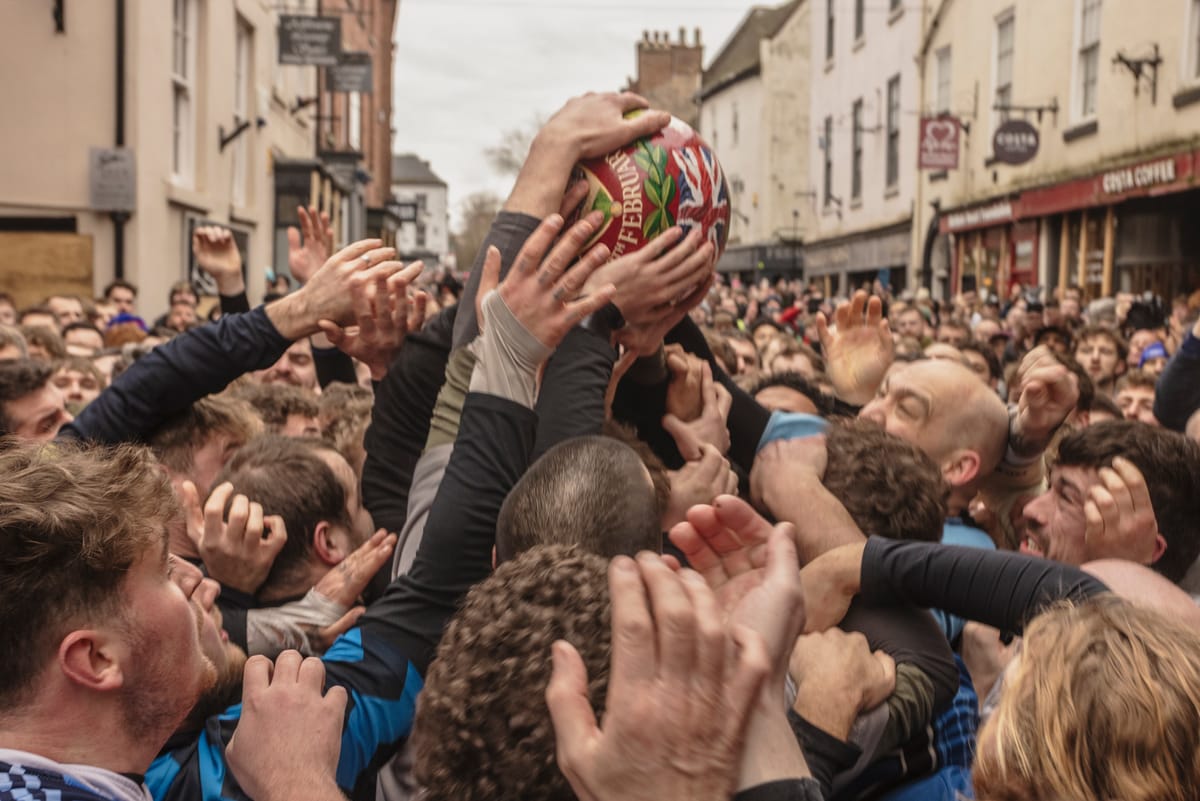
The exact origins of Royal Shrovetide Football are unknown. The most certain anyone can be is that it has been played in the small Derbyshire town of Ashbourne since 1667. Anything before that was reduced, quite literally, to ash. In the 1890s, a fire tore through the Royal Shrovetide Committee’s offices and incinerated the early records, along with any hope of a neat origin story.
Instead, all we have are rumours. One theory insists that public executions once took place in the town square, the severed head kicked and chased by medieval lads through the market place in a kind of bloodlust keepy-uppy. Another claims it began as a ritual parish game, a pre-Lenten explosion before 40 days of restraint.
Whatever its beginnings, the result is simple and brutal. Every Shrove Tuesday and Ash Wednesday, Ashbourne divides in two. If you were born north of the Henmore Brook, you are an Up’Ard. South, a Down’Ard.
At around 2pm, hundreds of men gather in a car park beside the town’s war memorial, where two doddery elders lead them in a rendition of Auld Lang Syne. This is followed by God Save Our King. There’s a brief pause and a taut, expectant hush. Then, an ornately-painted ball is thrown up and the crowd collapses into a heaving mosh. Faces knot, necks strain, bodies crunch. Over the next two days, the war memorial, built for one century’s violence, becomes the altar for another’s.
Or really, the entire town does. Shops board up their windows and businesses close, as the two teams try to wrestle the ball to stone goalposts at either end of Ashbourne, two miles apart. Play goes on until 10pm, but if the ball is "goaled" after 6pm, that’s it for the day.
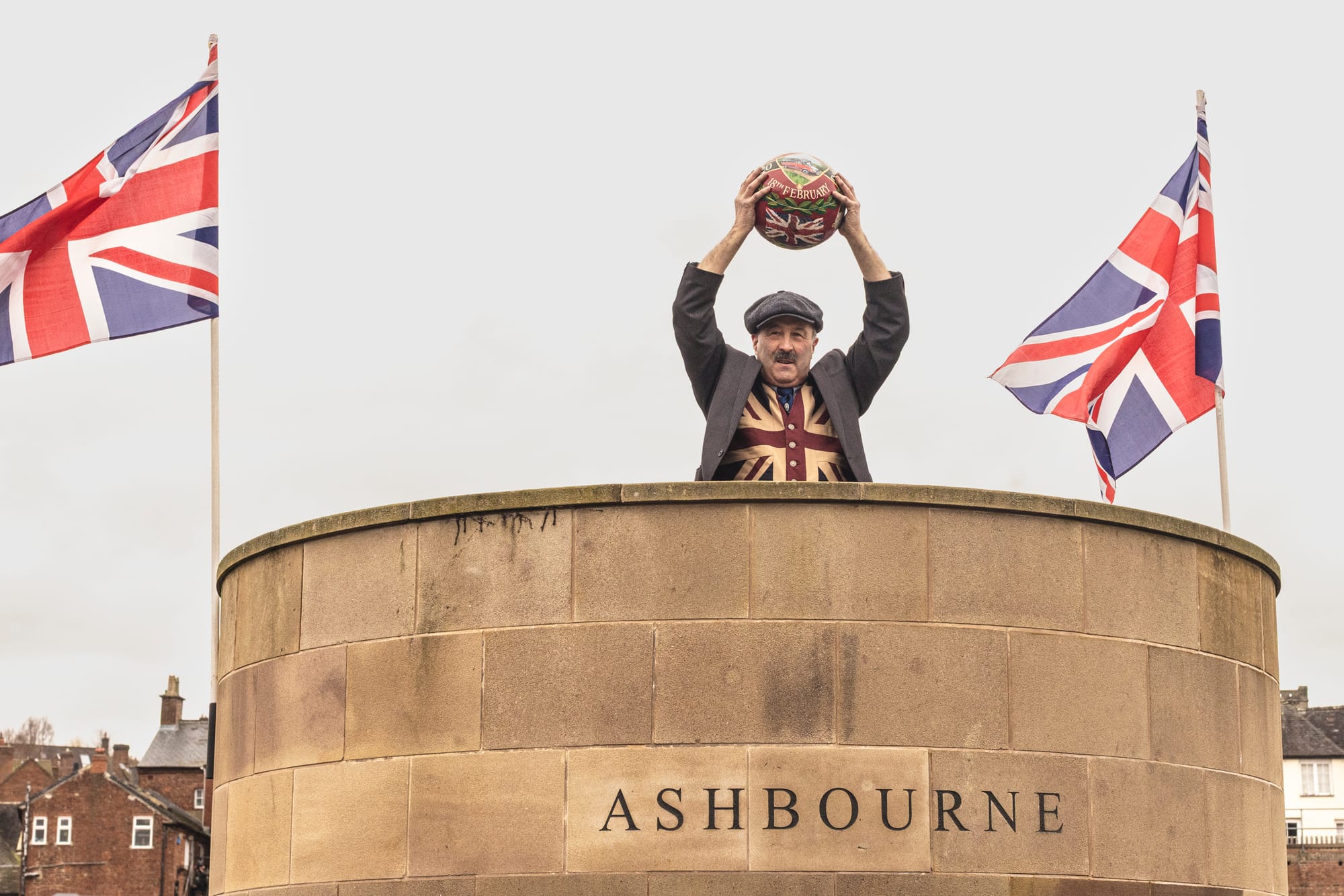
Beyond that, there are few formal rules. The churchyard and war memorial are no-go zones. Excessive violence is frowned upon but inevitable. There are no kits, referees, or visible structure. Identification is done by face and family and memory. Tactics are whispered in pubs. Alliances are inherited at birth.
And yet, despite this apparent lawlessness, the game has survived civil wars, industrialisation, two global conflicts, television and the smartphone. “Which,” Tim Baker tells me, “is why it is so special.”
Tim, 56, is the curator of the Ashbourne Historical Centre. He is an Ashbourne native, elegant and fashionable, wearing a pair of thick-rimmed statement spectacles. He is also an artist, and has painted every Shrovetide ball since 1991. “It’s a job for life,” he says proudly. “It’s yours until you give it up or drop dead.”
Register for free to read this article.