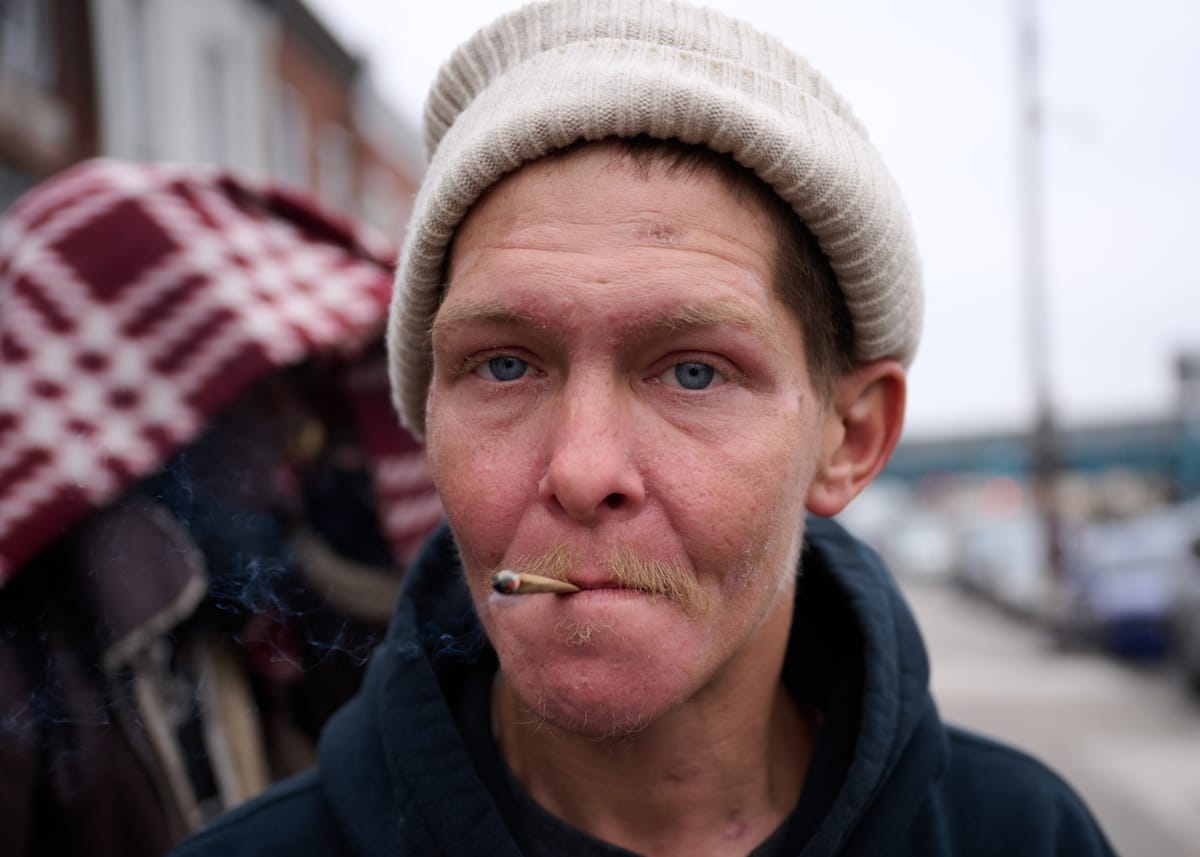
Folks come here for the drugs. Sons, daughters, mothers and fathers, all drawn by the promise of the strongest and cheapest highs in America. Somehow, they — the drugs and the people — always end up on Kensington Avenue in Philadelphia, the country’s most notorious open-air drug market.
For years the street ran on heroin; then gangs started putting fentanyl, or “fetty”, in the dope. Then came the animal tranquilizer xylazine, known locally simply as “tranq”. Now, there is something new: medetomidine.
Medetomidine delivers a shorter, more powerful high than the varieties of dope that preceded it, and the crash is faster and more brutal. By some estimates, it is 200 times stronger than xylazine. “There’s no stages to the high,” says Tony, who is in his early 30s and has a blue diamond tattoo next to his eye. “You go straight to sleep.”
To make up a hit, or “stamp”, the dealers mix the medetomidine with fentanyl, the ultra-potent synthetic opioid which continues to be the leading cause of overdose deaths in the US. The drugs are then packaged in small paper wraps, each stamped with a crew’s brand: “Hot Sauce”, “Pringles”, “Black Jack”, “Sunshine”. They cost $2 or $5, depending on the size.
“If I do a certain stamp, I have to do that stamp,” says Christine, a 41-year-old Philadelphian. She’s bundled in layers of coats, a purple hat casting a shadow over her hazel eyes. “I try to do other stamps, it won’t get me well.”

The effects of each stamp vary slightly from block-to-block due to a variety of other adulterants, but usually result in abrupt unconsciousness and extreme sedation. “You do it, you wake up, you’re sick,” says Christine. “You don’t even know you’re passing out.” But this isn’t like nodding off. Along Kensington Avenue, people shuffle in near-catatonic states, bent at right angles, frozen mid-stride.
Withdrawal from medetomidine arrives faster than heroin, fentanyl or tranq — sometimes within two hours — and is exponentially more punishing. Christine describes “brain zaps”, vomiting, mini seizures, paralysis, and violent swings in heart rate and blood pressure.
If Christine doesn’t hustle enough cash to stave off withdrawal, she will invariably have a heart attack and collapse on the street. She’s just been discharged from hospital with a grazed nose, the result of her fifth heart attack triggered by medetomidine withdrawal. She has been taking drugs on the streets of Kensington, sometimes sleeping rough, other times in shelters, for roughly three years since the last time she was “clean”. Her mother was addicted to heroin and she has had a difficult, chaotic life.
Kensington sits in the lower northeast corner of Philadelphia, just a few minutes from the hipster cafés of Fishtown and ten subway stops from the Pennsylvania State House, where the Declaration of Independence was signed in 1776. Today, it feels like another country entirely. Decades of abandonment, containment policing and a shape-shifting supply chain — forever mutating to outpace legislation — have hollowed the neighbourhood out.
Become a free member to read this article.