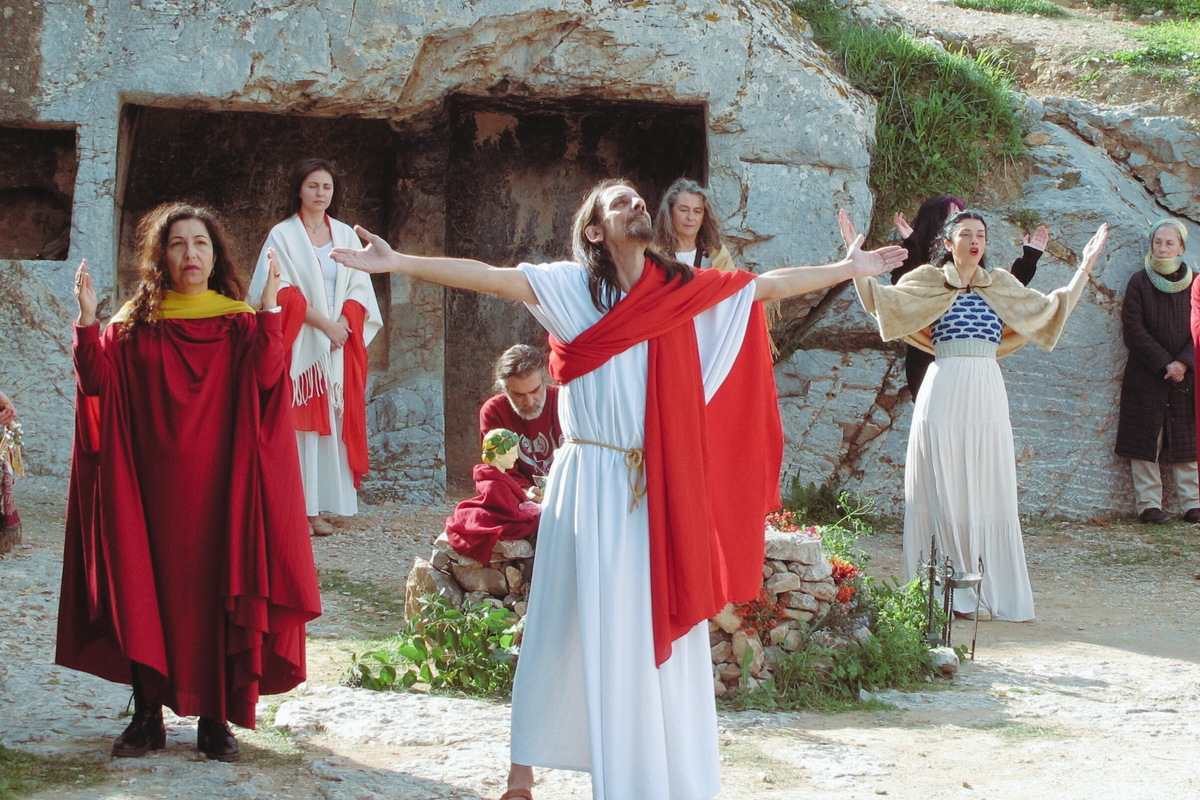
I first encounter Dionysus in a basement next to a souvlaki shop. He is dressed in a red tunic and a white mask with a long, curling beard. Around him, 13 Greeks in chitons chant through a haze of incense.
Bread and boxed wine are slowly passed around, and we are permitted three careful sips before pouring the rest into a brass bowl. We are meant to ask a favour from Dionysus in exchange for our saliva. I forget this last part, though later I make a retroactive wish for more money.
For millennia, the gods of Mount Olympus were viewed as historical artefacts, confined to myths and marble ruins. But over the past two decades, ancient Greek religion has undergone a gradual revival. Hundreds of Greeks gather twice a month to dance, sing, and make offerings to the old gods. Some meet at archaeological or symbolic sites; others gather more secretly, in private basements like this one.
Today's ritual is organised by Atthis, one of the main Hellenic groups at the forefront of Greece’s polytheistic revival. If it feels clandestine, that is largely because it is. Despite the movement’s growing numbers, devotees of the old gods face sustained opposition from both the Greek state and the country’s dominant religious institution, the Orthodox Church. In recent years, police, politicians, and clerics have all sought to impede the return of a faith long assumed to be extinct.
But the old gods are stubborn, and the ancient religion continues to attract new adherents. This is partly due to the determination of its spiritual leaders in Greece — and partly because of a new temple bankrolled by a wealthy doctor in London.
Ancient Greek religion is vague and multifarious. Unlike Christianity, it has no sacred text or fixed theology, but instead a lattice of myths, rituals and local traditions. They are open to interpretation and invite modernising tweaks.
Register for free to read this article.