
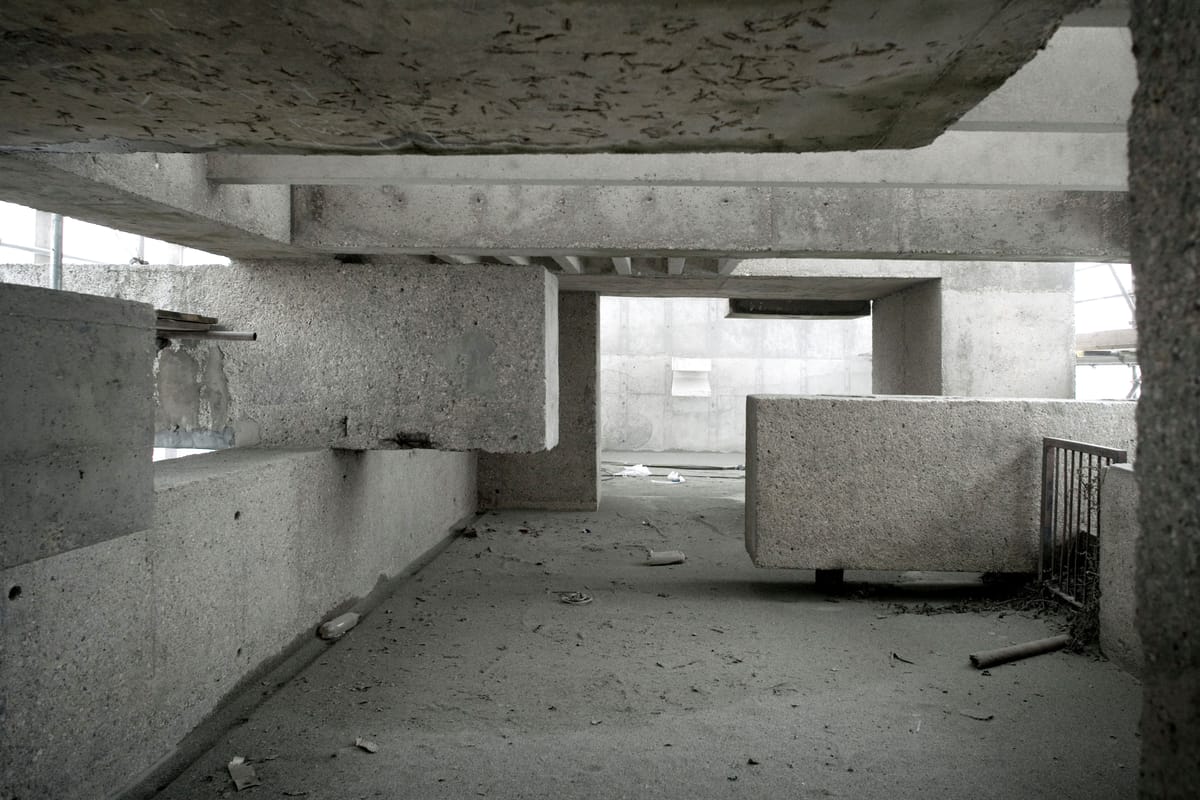
If you want proof that the North East of England is more than an impoverished backwater, come to Peterlee. Here, in the south-east corner of County Durham, it is still possible to witness the optimistic spirit of the mid-20th century, when this landmark “new town” — a masterpiece of modernist design and welfare state planning — arose in the early years of deindustrialisation.
Perhaps most movingly, in the centre of Peterlee’s social-housing network, you can experience the Apollo Pavilion, a remarkable open-air sculpture designed by the town’s chief architect Victor Pasmore. An enduring monument to the Space Age that gave birth to it, the Pavilion was created — so Pasmore claimed — “to lift the activity and psychology” of its surrounding community to “a universal plane”.
But while the ghosts of future past still circle in Peterlee, it’s also clear that the town, like much of the rest of the North East, has not been elevated by the political realities of the last few decades. In fact, far from it.
As Dispatch highlighted earlier this week, the latest statistics on the effects of opioid misuse show that the North East in general — and southern County Durham in particular — is now at the front line of the most recent public health emergency involving what has been darkly termed “deaths from despair”.

Why is the North East so often at the bottom of the league tables when it comes to such narratives, of which the data on opioid misuse is only the latest, most harrowing example?
Poverty, clearly, is a large part of the story. The child poverty rate in the North East has surged in the last decade, with Easington — Peterlee’s parliamentary constituency — behind only central Newcastle and nearby Middlesbrough and Thornaby East in suffering the worst regional effects of policies like the two-child limit on Universal Credit benefits.
But as the academic Christopher Saville has recently pointed out, economic hardship alone can only be half the story, given that former coal-mining areas, like those in County Durham and the wider North East, have a higher rate of deaths from despair than many other places experiencing similar levels of deprivation. Indeed, despite having deprivation rates comparable to other regions, the North East is now, by quite some distance, the leading English region both for deaths from alcohol-specific causes (25.7 per 100,000 population in 2023, compared to just 11.6 in London), and for deaths relating to drug misuse (10.9, compared to 4 in London). Its suicide rate is also the second worst nationally (14.5, almost tied with the worst-hit North West on 14.7, and almost double the London rate of 7.3).
It was inevitable that England’s most northerly region would not be raised up to an astral plane by idealistic schemes like Pasmore’s development of Peterlee in the 1950s and 1960s. What is not so predictable is why it should have become something like the national capital of despair in the years since.
For those on the front line of the despair epidemic, the picture is understandably microcosmic. In the North East’s regional capital of Newcastle, workers at PROPS — a specialist family drug and alcohol service in the city’s west end — are keen to underline that addiction is a many-armed monster, which defies easy rational analysis.
This is not a paywall!
To read this rest of this article, register for free.