
Investigating UFOs is not sexy. It is boring. And hard. It is the trainspotter’s X-Files. The evidence is scant, and, thanks to the Pandora’s box of generative AI, it is now harder than ever to tell what is real. Compared with the quaint days of dodgy film negatives and blurry camcorders, even the most convincing image can no longer be trusted.
Serious UFO hunting is a matter of vetting and scepticism, of spreadsheets and hours of data entry. It involves long drives to the middle of nowhere, endless Freedom of Information requests, report writing, filing — and, inevitably, mockery from friends and family. This is all the more punishing if you are British.
British ufologists lack the Hollywood allure and frontier mystique enjoyed by their American peers. When they are not writing entries about Mansfield’s flying saucers into spreadsheets after a 9-to-5 shift, their evenings are spent stargazing on chilly hilltops with doggers and teenagers smoking joints.
Most people would find this gruelling. Most people are not cut out to chase UFOs. Others, though, are born to watch the skies.
It is 9:40pm on a cold Wednesday on a hill by Anglezarke reservoir in Lancashire, and Ash Ellis does not complain once. The 39-year-old is one of five UFO spotters wrapped in scarves, hats and heavy coats, their necks craned upwards. They have gathered for a “skygaze” — an ambitious attempt to spot unexplained flying objects firsthand. The night has been organised by UFO Identified, a group Ellis founded.
UFO Identified is, according to Ellis and his team, the most active group dedicated to investigating unexplained phenomena in the UK. Ellis previously worked for the country’s oldest ufology group: the British UFO Research Association (BUFORA). But he found BUFORA’s methods too slow and dated, so he started to run his own group in tandem. According to Ellis, he was committed to both groups — but BUFORA kicked up a fuss, and he splintered off in April 2020.
“They didn't like that I was doing my own thing,” says Ellis. “I was like: ‘Well, we’re doing more and I think we're doing better than what you’re doing.’”
He soon recruited a core team, none of whom had been in BUFORA: Abigail Hyslop, a civil servant with a degree in biology; Natalie Pearce, an operations manager at a care home; and Steve Yarwood, a hospital porter. All live in the North West, and though the group remains small, UFO Identified has volunteer outposts scattered across the Midlands, the South East and Scotland. It has ambitions to expand further. If they are to win the ongoing power struggle over the future of British ufology, they will need to.
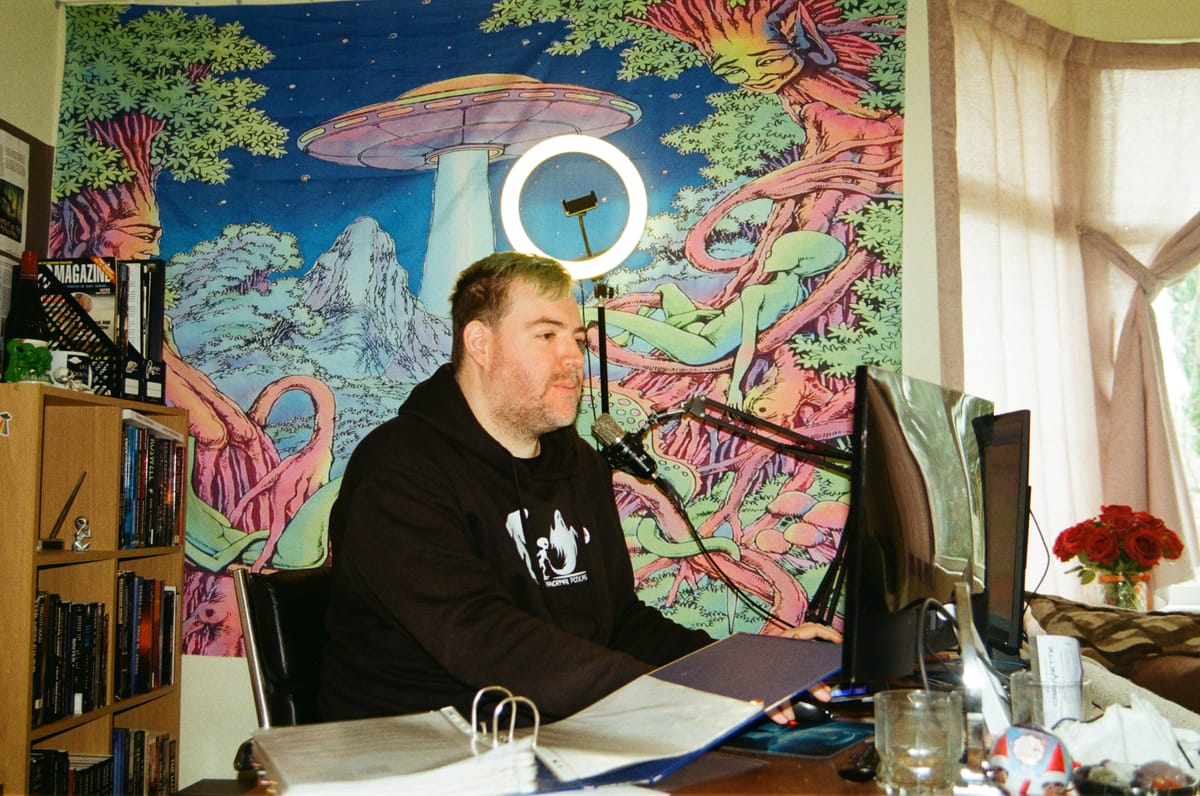
On a dry, drab morning in Sale, Manchester, the kind of overcast sludge that makes UFO spotting impossible, Ellis leads me into his living room. A quarter of it has been given over to UFO Identified. There are books on triangular spacecraft and the infamous 1947 Roswell incident in New Mexico, little green men in see-no-evil, speak-no-evil poses, and a mug emblazoned with UFO Identified’s logo.
This is not a paywall!
To read this rest of this article, register for free.