
In 2023, the Brussels-Capital Region commissioned a new slogan for Belgium’s capital. The process was quintessentially Brusselian: an 18-month consultation exercise, followed by a bespoke “brand toolkit”, culminating in a glossy launch party.
The whole thing cost €600,000. The slogan they settled on was “perfectly imperfect” — a phrase that managed, in its own perfectly imperfect way, to glide over the increasingly harsh realities of life beyond the city’s diplomatic quarter.
Ten years after the United Kingdom left the European Union, much will be written about the state of the former: the rogue nation that voted to leave and then, seemingly, began to regret its decision. But what about the bloc it chose to leave behind?
If the EU has a beating heart, it is in Brussels, and the city advertises itself accordingly. There is the European Commission and the European Parliament, the UNESCO-listed Grand Place, the NATO headquarters, and more than two dozen UN agencies and liaison offices. When its various bodies are in session, EU diplomats and bureaucrats drift between polished conference halls and cocktail receptions, speaking the language of unity.
All of which makes the contrast with the city’s day-to-day reality more arresting. In Brussels, stately ambassadorial residences and lavishly ornamented grand squares give way to encampments of homeless people, communities of undocumented migrants, and mountains of uncollected rubbish.
Most troubling of all, though, is the drug-related violence, which has surged in recent years. Last year, Brussels saw a record 101 shootings, nearly double the 56 incidents reported in 2022. Today, the kind of mayhem long associated with cities like Marseille — and later Antwerp — seems to have taken root: stabbings and shootings in broad daylight, young men carrying Kalashnikovs through busy metro stations, the city's chief public prosecutor living under permanent police protection.
While the violence touches much of Brussels, a few of its 19 municipalities have been hit especially hard. Anderlecht is one of them. In March, after six shootings in a single week — including three within 24 hours — the local mayor ordered extra police patrols onto the streets. When I visited earlier this year, my host’s apartment was on a road where, two years earlier, a man was found shot 17 times with a military-grade weapon.
A settling of scores, the neighbours said. Increasingly, that explanation is all anyone offers.
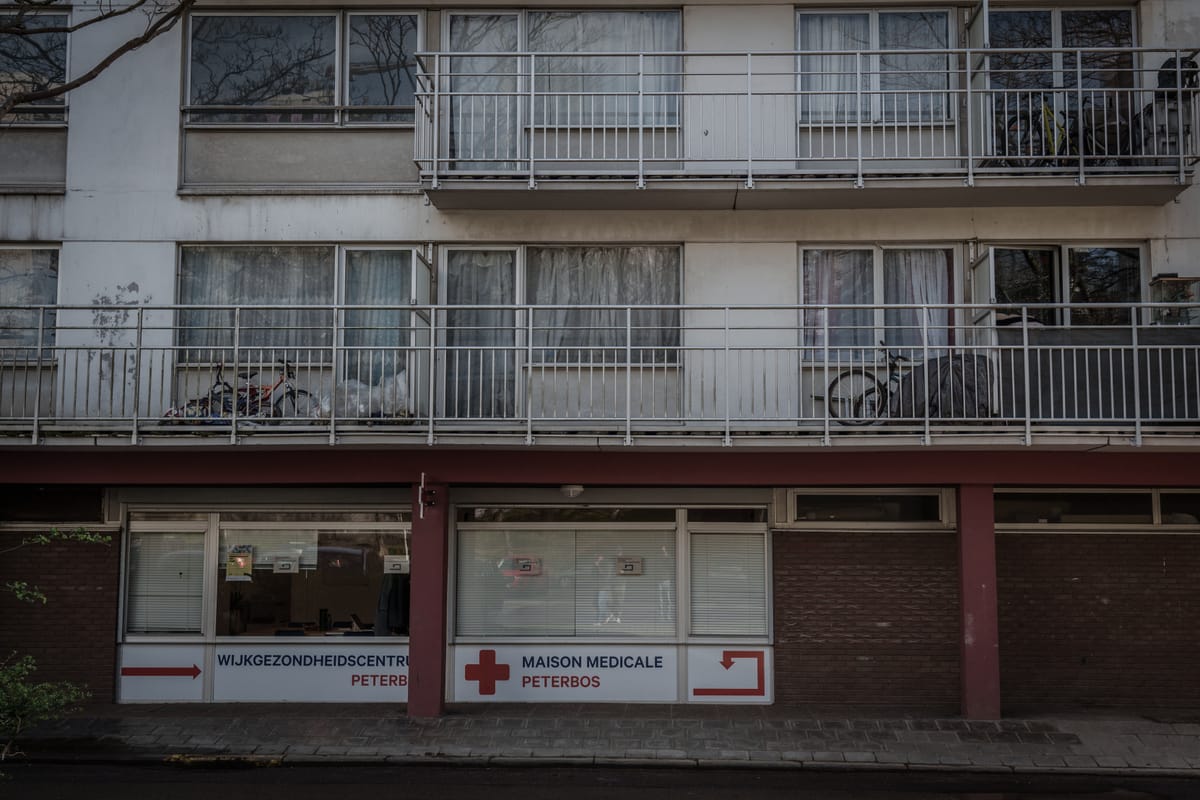
Peterbos is one of Anderlecht’s most notorious neighbourhoods: a banlieue-like social-housing estate built in the 1960s as a modern, green residential area. Following decades of neglect and disinvestment, however, its 18 tower blocks proved ideally suited to something its planners never intended. Drug gangs operate here with near impunity.
Social worker M'hamed El Ouali has been working in Peterbos for years with SAAMO, a community social work organisation. He has agreed to show me around with his colleague, Mohamed Fallouj.
"This is one of the hotspots," says Fallouj, 32, as we drive towards Peterbos, passing Aumale, a small square in Anderlecht with a metro station and a handful of cafés. "Around 70% of the coffee houses in this neighbourhood are dealing spots." Across Brussels, authorities have officially designated 17 such areas where police presence is heightened and officers’ powers are expanded.
You'll need to become a paid member to read the rest of this article.
Reports like this demand weeks of research, writing and editing — and our paid subscribers are what make that possible.
But here's the good news: for three months, you can join them by paying £4.95 a month to access everything.