
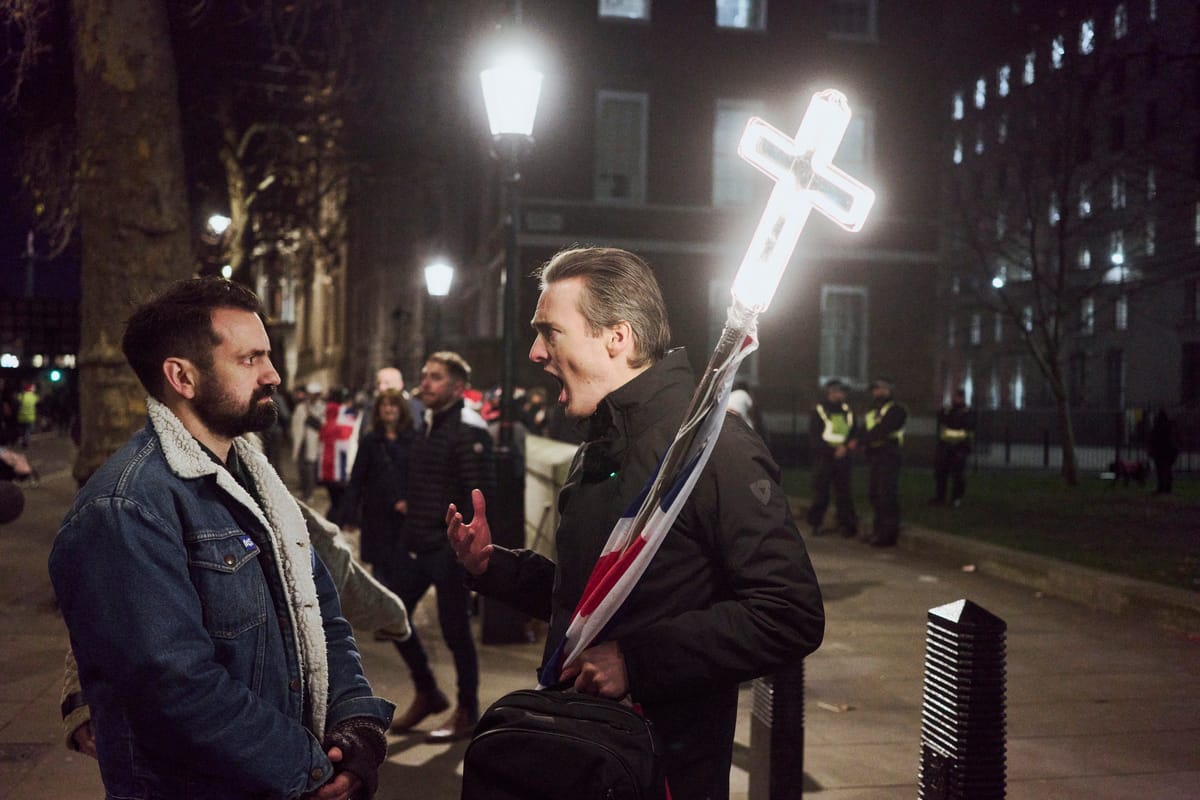
On a slow Saturday afternoon in Yeovil, the only real things to do are get drunk in the Wetherspoons or try to find God. Twenty of us — all men — have opted for the latter. We’re gathered in a musty Methodist church, a place whose pews haven’t been full for nearly half a century, and which now serves mostly as a weekday crèche.
This weekend, it has been repurposed for a slightly different purpose. A rainbow-coloured Pride insignia, promising that “Everyone is welcome”, is being hurriedly dismantled. From an electric piano manned by a lanky, dour teenager with a surprisingly angelic voice, an ethereal harmony floats across the room.
Men, young and middle-aged, raise their hands, get on their knees and praise God. Behind me, someone starts to talk in biblical tongues. This is Fathers Arise, a spiritual weekend for Christian men that has something for everyone: from advice on how to get along better with your wife, to tips about the coming spiritual war in Britain between the forces of good and evil.
My journey to Fathers Arise began with an encounter with the devil outside the Greggs in Guildford on a Friday afternoon. Max, 34, a man built for road construction work with a sleeve tattoo, had just finished work and travelled into town to meet Ollie Sabatelli and Jesse Ngoma, a pair of Instagram street preachers who between them have more than 650,000 followers.
“Release him Satan, in the name of Jesus, all the fear that the devil has placed in your life,” Olly bellowed into his microphone, one hand planted firmly on Max’s chest. A few weeks before, the preacher from Croydon had announced that the Holy Spirit had instructed him to go to Guildford declaring — to the surprise of its residents — that the terminally dull Surrey commuter town was “full of demons”. Other itinerant preachers soon followed, descending from across the country to denounce everything from consumerism to the malign cultural influence of Ed Sheeran, who had once attended the town’s music academy.
Over the following weeks, I travelled back and forth to Guildford, watching a steady, awkward pilgrimage take shape. Young men were baptised in the River Wey, watched on by bewildered pensioners and ducks. There was Stephos, the 19-year-old who had heard the voice of God while homeless and sleeping under a scaffold. There was Emmanuel, a care worker from Ghana, who had come to Guildford believing that he was fulfilling a prophecy given to him at the age of 15: that he would one day return to the land of John Wesley, whose preaching had sparked Britain’s last great Christian revival in the 18th century.
“Britain had once been ordained by God for great things,” Emmanuel told me outside the town’s TK Maxx before preparing to preach. Since arriving in England two years ago, however, he admitted the trappings of this divine glory had faded. One day it might return. But before the light, he told me in a gentle lilt, there is always darkness.
Since the pandemic, talk of a Christian revival in Britain has become a minor press genre. Much of it rests on a statistic from the Bible Society that shows Church attendance has risen slightly since the pandemic. The largest increase has been among Gen Z and in Catholic and Pentecostal congregations — a trend also shaped by immigration from sub-Saharan Africa. This has produced a run of heartening, if faintly glib, stories of young men vox-popped outside London churches, explaining their conversions in the language of wellbeing and improved mental health.
Register for free to read this article.