
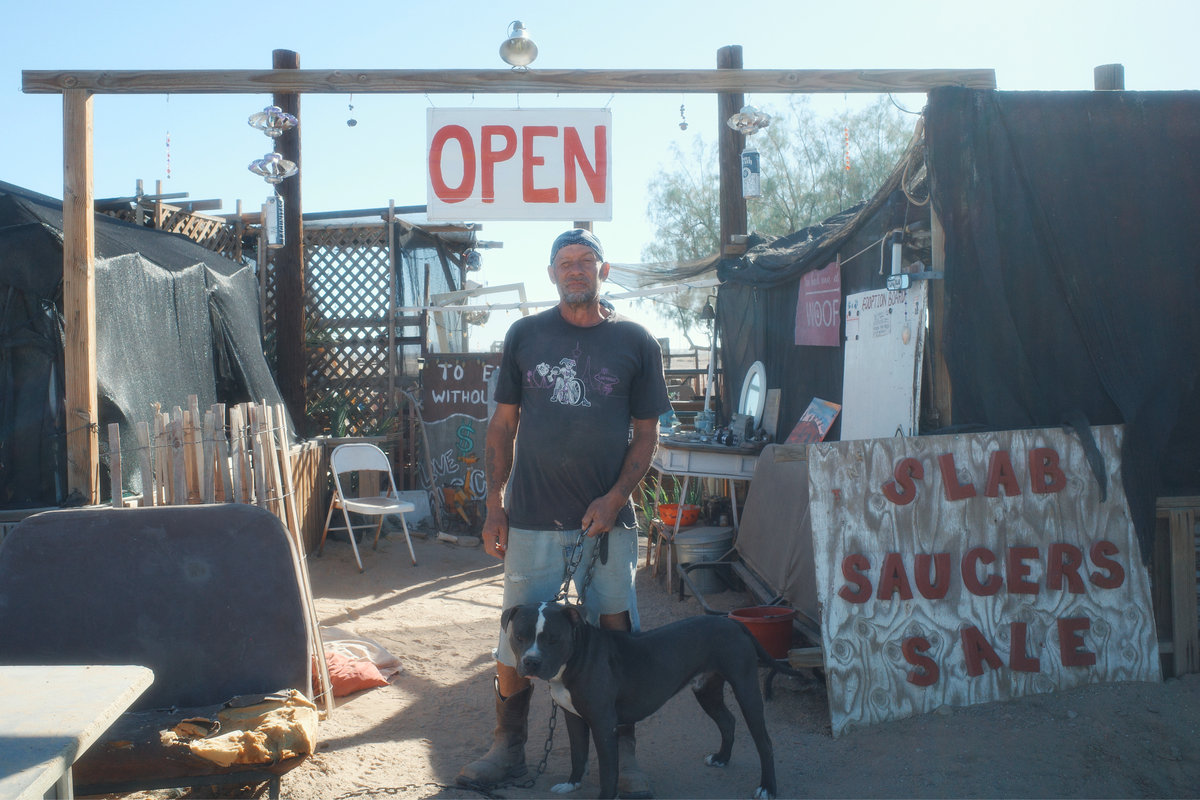
“Everyone here is insane,” says a man who introduces himself as Wizard.
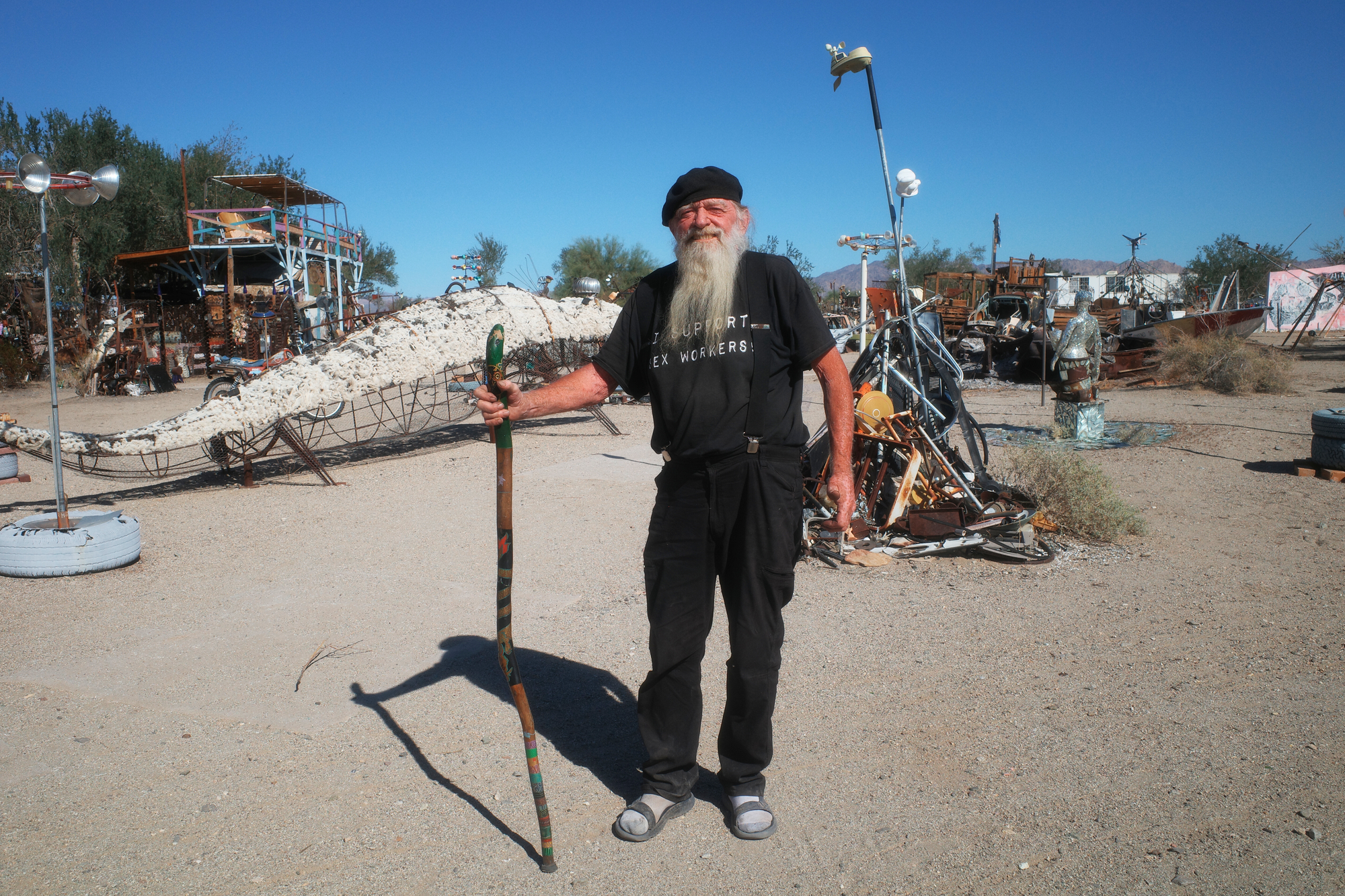
He is holding a staff, and uses it to gesture to the desert around us. A long white beard trickles over the slogan on his T-shirt: “I support sex workers."
Wizard, in his late 70s, has lived in Slab City for close to 30 years. He describes himself as an amateur sociologist, which is a polite way of saying he has spent decades watching broken people arrive, then try (and normally fail) to knit themselves back together.
Slab City is often described as “the last free place in America”. In reality, it’s a collection of semi-permanent camps squatting on federal land in Imperial County, Southern California. There is no running water, electricity, taxes, or government infrastructure of any meaningful kind.
Instead, RVs sit alongside homes hammered together from reclaimed wood and corrugated metal. On the outskirts, tents sag and tear in the desert wind. Everything is the colour of old blood and oxidised tin, shimmering in desert heat that soars beyond 50°C (120°F).
Slab City is a mythic place, the subject of endless breathless documentaries and photo essays. Usually, it’s framed as some sort of anarchic utopia, a frontier fantasy played out in real time. Slab City is, we're told, about Americans opting out, artists rejecting capitalism, veterans finding peace off-grid.
But how does that fantasy play out in reality?
Today, depending on the season, anywhere from a few hundred to a few thousand people live in Slab City, and few would describe it as a utopia. Drugs are everywhere. Crime exists, if unevenly enforced. The heat is punishing and the living conditions are brutal.
People who have slipped through the cracks of American life arrive carrying trauma, addiction and paranoia, and the desert has a way of amplifying it all. If Slab City really is the last free place in America, what does that say about the rest of the country?
If anyone’s to blame for Slab City, it’s the US military. During the Second World War, American strategists believed this stretch of desert, 50 miles north of the Mexican border, would be the perfect place to prepare troops for a potential North African campaign. It was hot, arid, brutal — a convincing simulation of the Libyan or Tunisian desert.
Register for free to read this article.