
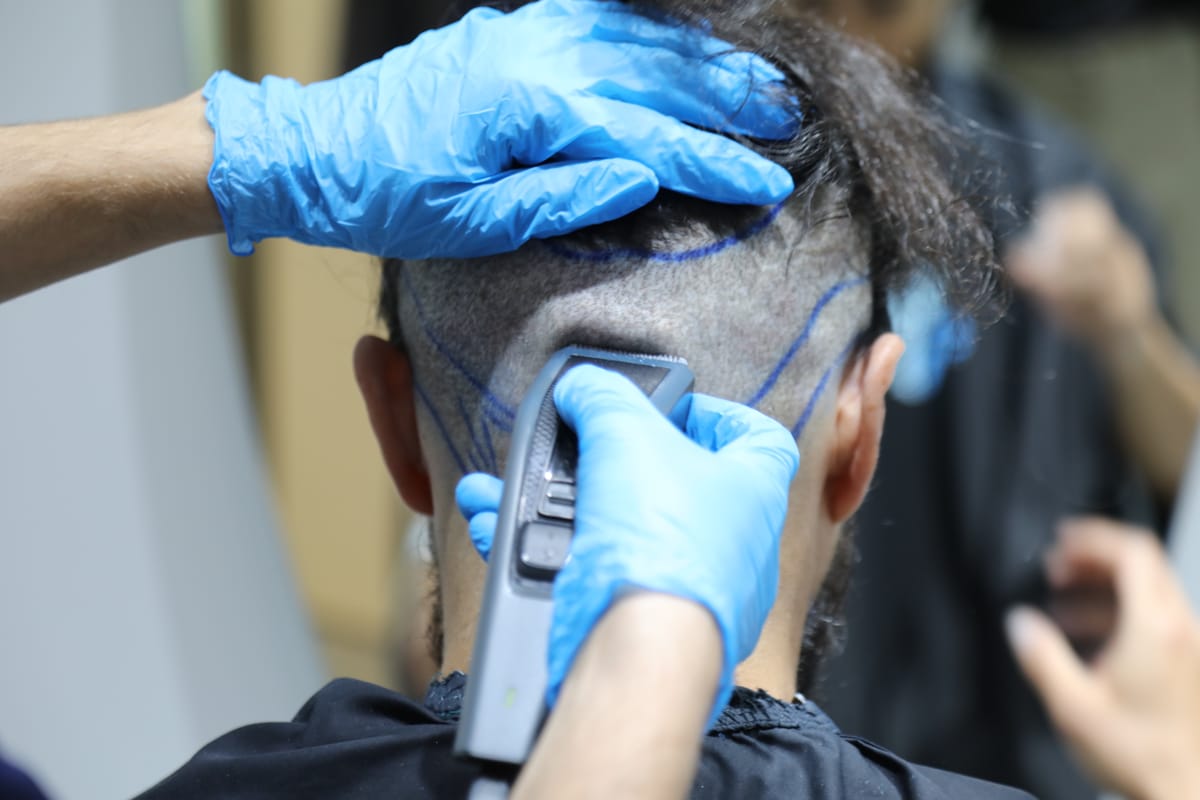
As Istanbul’s baking sun beats against the windows of the air-conditioned clinic, a man with a round, freshly shaved head lies waiting for his new, proudly hirsute life to begin. Blue lines curve across his scalp, marking out the hairline he has paid to acquire.
Encircling him is a team of three specialists who have done this hundreds of times before. One repeatedly injects his scalp with saline, swelling the skin to make it easier to work on; another begins inserting follicular grafts into the bald corners of his forehead. The third discards the used, pen-shaped transplant tools into a tray, where a small pool of blood is beginning to form.
By the end of the procedure — which can last more than 10 hours — thousands of individual grafts have been moved from one part of his head to another.
“We don’t cut any corners,” chirps Sherry Arjomandi, the clinic’s head of marketing, as we watch the fluorescent-lit scene from a silent corridor. “We have the best standards.”
There are 65 operating rooms inside the Elithair Clinic, which bills itself as the largest hair-transplant clinic in the world capital of hair transplants: a city sometimes nicknamed “Hairstanbul”. The clinic occupies a 13-storey, 18,000-square-metre tower and employs around 350 people. Among the treatments advertised are the Choi Implanter Pen, used to insert follicles, and “Sleep-Deep”, a form of sedation that the clinic says allows patients to undergo the procedure without pain. There is also an Elithair range of aftercare serums. Packages start at a little over £2,800, with prices generally two or three times lower than in Europe and the US.
Each arrival goes through a comprehensive set of pre-procedure checks: tests for diseases such as HIV or hepatitis, high blood pressure, and other conditions that could lead to complications. The previous day, a patient with haemophilia had been turned away because operating on him was deemed too risky. Even so, Elithair can perform as many as 180 procedures a day. The overwhelming majority of its customers are men, though there are some women.
Elithair, which also has consultation centres in Germany, Dubai and the United States, is merely the crown on the head of Türkiye’s world-leading scalp restoration industry.
According to official figures, 1.39 million foreign patients travelled to Türkiye for medical services, last year, the majority for hair transplants, generating about $3 billion in revenue. They came from Europe, Asia and the Americas, drawn by low prices, all-inclusive packages and an enormous network of clinics. These have thrived thanks to relatively low labour costs, top class transport links, and government subsidies covering rent, international marketing and air travel for foreign clients.
For a certain kind of balding man, Istanbul has become a place of pilgrimage.
The pilgrims are not difficult to spot. In Istanbul, there are more than 650 hair transplant clinics, according to some estimates; others put that figure at a scarcely believable 5,000.
In scenes befitting Black Mirror, entire neighbourhoods of the city bustle with men sporting bloodied white bandages like an army of skinhead soldiers returning from war. A couple of days after surgery, some graduate to black headbands, worn to stop the saline injected during the procedure from draining down into the face.
You'll need to become a paid member to read the rest of this article.
Reports like this demand weeks of research, writing and editing — and our paid subscribers are what make that possible.
But here's the good news: for three months, you can join them by paying £4.95 a month to access everything.