
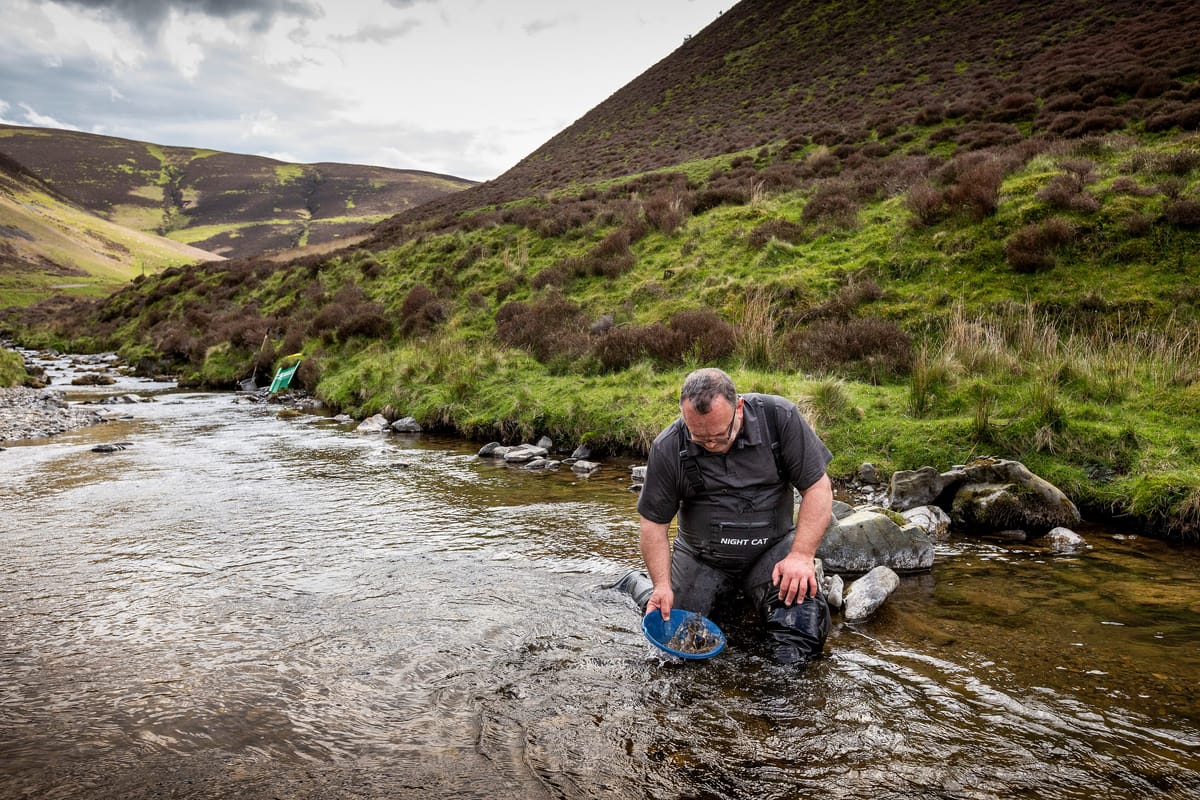
The thing about gold is that it’s trying to return to the centre of the earth. At least, that’s what 51-year-old fish and chip shop owner David Armstrong tells me as he stands knee-deep in the Mennock River, peering intently into a plastic pan of dirt he swills gently clockwise.
It’s an unseasonably warm and bright day in Dumfries and Galloway, southern Scotland. The sun bounces across the water and illuminates David’s sizable kit: a shovel, a bucket, a gravel pump leaning against the riverbank, a plastic “sluice” (a kind of portable trough used to quickly sift dirt and gravel) positioned carefully where the current runs over the rocks.
But David has only one glimmer in his sights: we’re here to look for gold. He calls to me as I watch on from the bank: “There’s a lot of black sand here, so we might just be in luck.”
David, from Edinburgh, describes himself as “probably Scotland’s most prolific gold prospector”, spending around 200 days a year criss-crossing the nation in pursuit of the precious treasure. There’s a lot of it to be found; wherever there’s a hill, he tells me, there’s likely to be gold. And David has plenty to show for his efforts: two jam jars full of gold nuggets, a set of colour-coded maps that “lots of people would kill for”, three slipped discs in his back, and 120,000 miles on his four-year-old pick-up truck.
He’s been keen to manage my expectations before setting out for the river. Usually, he’d spend the best part of a day here, but we only have half an hour. It’s just a chance to show me how the process works, and we might not find a thing. But just 15 minutes later, he is beaming over at me: we’ve struck gold.
I crane my neck to peer into the pan, and it takes my eyes a moment to locate what they’re meant to see. To call it a speck is generous. At first, I mistake it for a particle of dust. But then, it catches the sun and sparkles undeniably.
“Gold stands out like nothing else. It shines like it's covered in a high-vis,” David says proudly, with the same enthusiasm as if we’d just dredged a popcorn-sized nugget out of a puddle. “You can’t miss it. It just shines like a star.”
Today’s haul, he says, is probably worth about one or two pence in current prices. But that’s far from the point. As I come to learn, for most panners at least, monetary value is the least precious thing about gold.
Ask a prospector to explain prospecting and you’ll likely get a primer in geology. Gold is formed in quartz, which corrodes over time in water, leaving the gold to wash out into streams and rivers. It’s heavy and dense — it’s trying to get back to the centre of the earth, remember — so it keeps going down until it hits bedrock or clay, gathering in areas of low water pressure. That’s where prospectors dig, using their sluices and pans to run water through the gravel so that the gold sinks to the bottom and the rest can be washed away.
But that’s to say nothing of the different techniques at play. On top of his gravel pumps, sluices and a selection of different pans, David is increasingly getting into “sniping”, he tells me, where prospectors get kitted out in a full drysuit to lie face-down in the river with a snorkel, seeking out cracks in the bedrock. Others make use of waterproof metal detectors. Across the Atlantic, the Canadians (unlike British prospectors) are allowed to use mechanised equipment.
And then there are the competition panners.
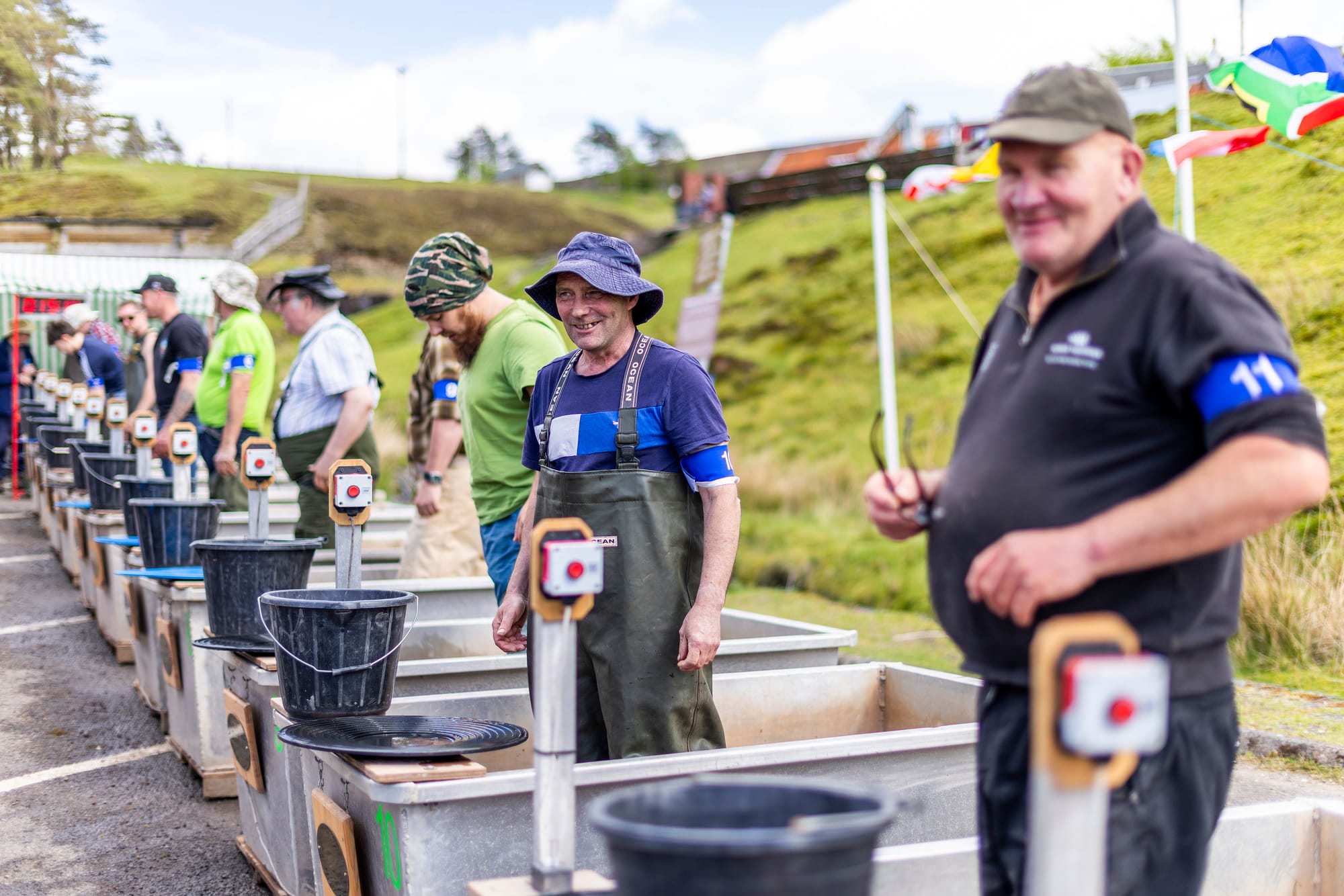
On this sunny Scottish day, I’m not just here to cheer David on from the banks of the Mennock. A few miles along the Mennock Pass, a scenic country road dotted variously with potholes and sheep droppings, is the Wanlockhead Museum of Lead Mining. And this weekend, it’s playing host to the annual Scottish and British Gold Panning Championships.
You'll need to become a paid subscriber to read the rest of this article.
The good news?
Our summer sale has just launched, making it the perfect time to join!
Subscribe below to keep reading — and help fund our deeply reported independent journalism: