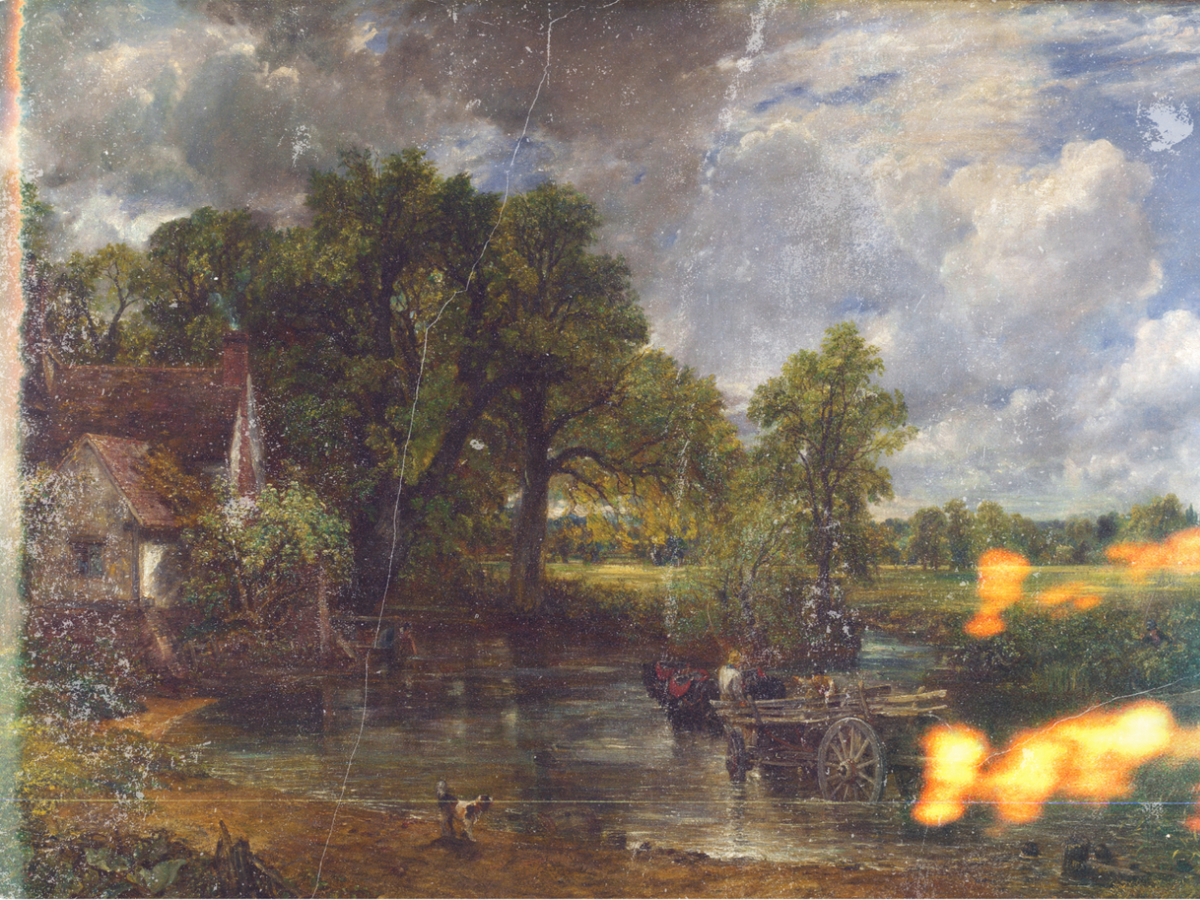
The landscapes of Dedham Vale, following the River Stour along the Essex-Suffolk border, are neither the maritime sublime nor the cliff-edge wonder associated with imperial Britain. Nor are they home to ruins that might act as symbols of past grandiosity. You’ll find no Stonehenge or Tintern Abbey here.
Instead, Dedham Vale offers miles and miles of flat fields and riverine wanders, of pretty churches in chocolate-box villages. The Vale’s wonder has never been the awe of its sight, but the fact that it doesn’t simply doze off.
And yet, these East Anglian places are also quintessentially English landscapes, chosen for Lovejoy’s cosy-crime fictions and the quiet hauntology of The Detectorists. Fittingly, painters still flock to the region, albeit none as famous as those who brought fame to the Vale: John Constable, Thomas Gainsborough, John Nash, and Alfred Munnings.
And Tom Keating, of course.
Keating may not be as “household” a name these days, but there was a time in the late ‘70s and early ‘80s when he was unquestionably the Vale’s most famous living artist. His paintings and sketches of East Anglia were printed in books by eminent art historians, sold for thousands at auction, and hung in prestigious homes and museums.
In fact, one could argue that Keating’s paintings are among the most prescient and vital landscapes made at the time. Partly because Keating was good at what he did. And partly because his paintings were forgeries.
When Tom Keating rose to prominence in the ‘70s, he looked like Father Christmas. That’s what everyone said, be that an esteemed arts journalist like Geraldine Norman, an antiques dealer like Julian Birch, or Jane Kelly, the Canadian girlfriend 30 years his junior. But it’s safe to say that Keating himself, rake of the art world and avowed socialist, imagined his white hair and bushy beard as resembling not Saint Nick, but Karl Marx.
Register for free to read this article.