
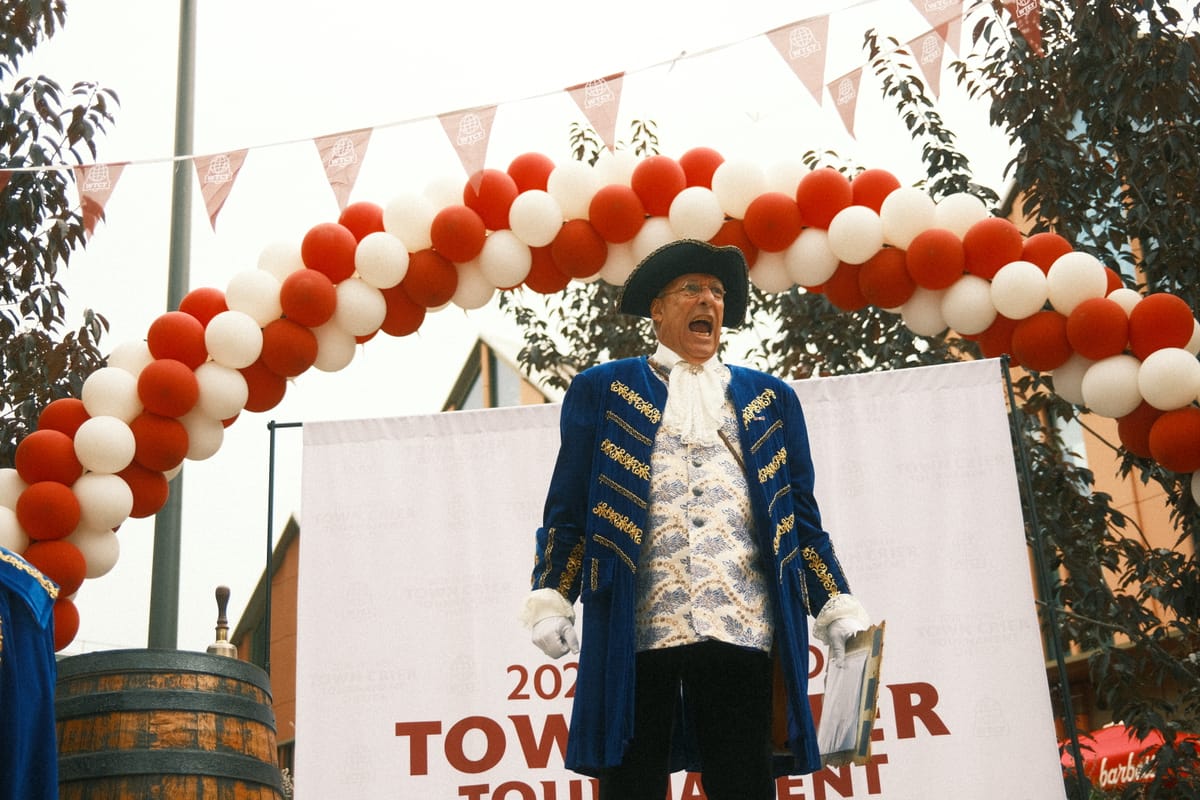
Flanked by a pair of headless mannequins, one in a swimsuit and the other in lacy undies, the town crier for Haslemere was delivering one of the most important orations of his life. “Pour Moi is more than a lingerie and swimwear shop," began Christian Ashdown, in the stentorian style of a drill sergeant. "It is a celebration — of confidence; individuality; comfort; and style.”
Wearing white gloves, a top hat and frock coat, Ashdown, in his Victorian ensemble and military bearing, radiated a headmasterly rectitude, particularly to those who weren't listening. With resolute sincerity, he extolled a “community of cheerleaders” that inspired women to “celebrate themselves and shine every single day”. With a knowing grin, he raised his hat with a rod-straight arm: “God save the King!”
As shoppers ambled past the stage in Eastgate Square, an indoor shopping centre in Chester, few could have grasped that they were bearing witness to a career-defining competition.
This was day two of the World Town Crier Tournament, at which 25 town criers from eight nations — including Belgium, the Netherlands, Germany, the US, Canada and Australia — were competing for the distinction of being the best in a millennia-old business. The tournament's host city, Chester, is Britain's town crying capital: it has employed one for more than 470 years, and is also the last city in the UK to retain, albeit only through the summer months, a daily town cry.
This year, the British town criers were a strong shout to win. They had the numbers, for a start: there were nine competing in Chester. And their dominance was buoyed by a growing cohort of homegrown criers, even as the profession worldwide has faced its twilight for more than a century. Over the past decade, the Ancient & Honourable Guild of Town Criers (AHGTC), the larger of two organisations that administer British members' affairs, has increased its membership by about 20% to 170. Globally, though, the figure has slumped to fewer than 500.
The task of presenting the best of them fell to David Mitchell, the crier for Chester, whose resting expression suggested an incurable amusement. “We can't start immediately,” he announced, spotting some empty seats. “Town criers, will you please grab passersby — forcibly — and tell them they're not leaving until at least 12 o'clock.” Regarding a possible detainee, a woman in her 40s with a brisk step and a smart bob, he relayed her excuse as she escaped: “Court case, apparently.”
How do you win a town crying competition, anyway? Surprisingly enough, it takes more than a big gob. The World Town Crier Tournament was assessed by a panel of five judges, marking for — besides vocal proficiency — “accuracy” (points deducted for stumbling or going off script), “content of cry” (was the script worth sticking to?) and the beauty-pageanty category of “confidence and bearing”. Above all, the contest measured the strength of professional personality — whether criers were proclaiming their hometown, as they did on the opening day, or, as on the retail theme of day two, praising the slimness of a fashion accessory as “a fanny pack on Ozempic”.
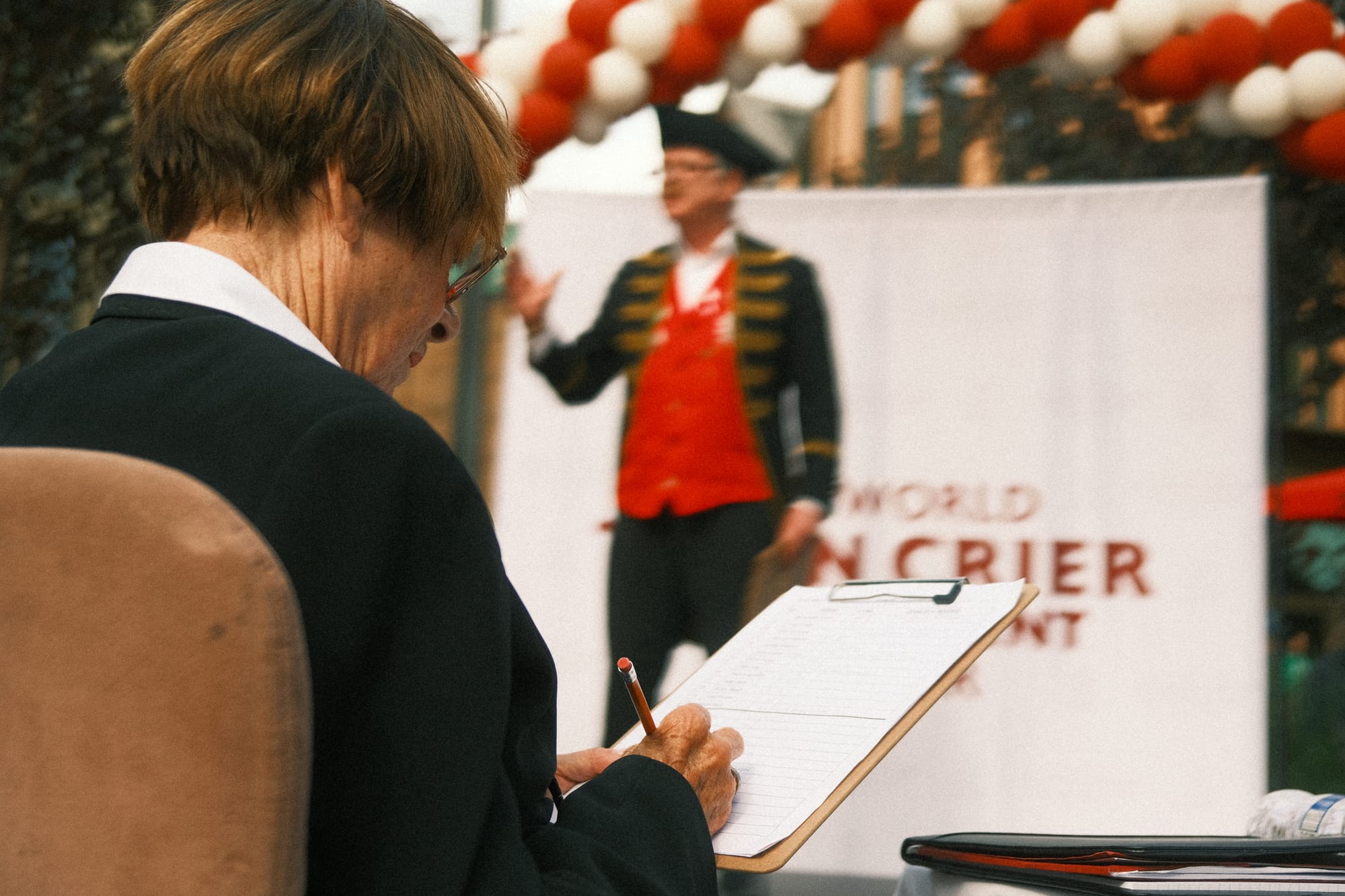
In England, most town crying competitions — there were more than 20 this year — are overseen by two guilds. One is the aforementioned AHGTC, founded in 1978 in part to add formal rigour to contests; the other is the Loyal Company of Town Criers, established in 1993 to better serve criers residing in the north (though not as far as Scotland, where only three criers remain). For this tournament, the rules were set by Mitchell himself, who, like many criers, is a member of both guilds. “That's why the rivalry is so nonsensical,” he told me.
Under Mitchell's rules, the tournament in Chester allowed copious use of props (such as mannequins) and encouraged criers, through another judged category, to engage the audience — big no-nos for AHGTC competitions. Ashdown, the chair of that guild, argued that their “purist” approach was a foil against the diminishing returns of a cheap laugh. “It's a bit like wearing a T-shirt that says, ‘You don't have to be mad to work here, but it helps’,” he said.
Jon Bartholomew, the crier for Bexhill-on-Sea and a late withdrawal from this tournament, was more forthright, warning that the comedic elements common to the Loyal Company competitions risked “belittling” the role's civic function. “I am on stage when I deliver a cry, but I do not go on stage to entertain the public,” he said. “I'm not an entertainer. I'm not a clown.”
As if to further upend tradition, among Mitchell's rules, set out in an 18-page document, was a proposal for criers to omit the stock salutation — “Oyez, oyez, oyez” — and the standard valediction, “God save the King.” Suggested for the sake of variety, this guidance set a precedent that took town criers further away, Bartholomew thought, from being the “monarch's messenger”. In that light, Ashdown's cry carried a frisson of rebellion.
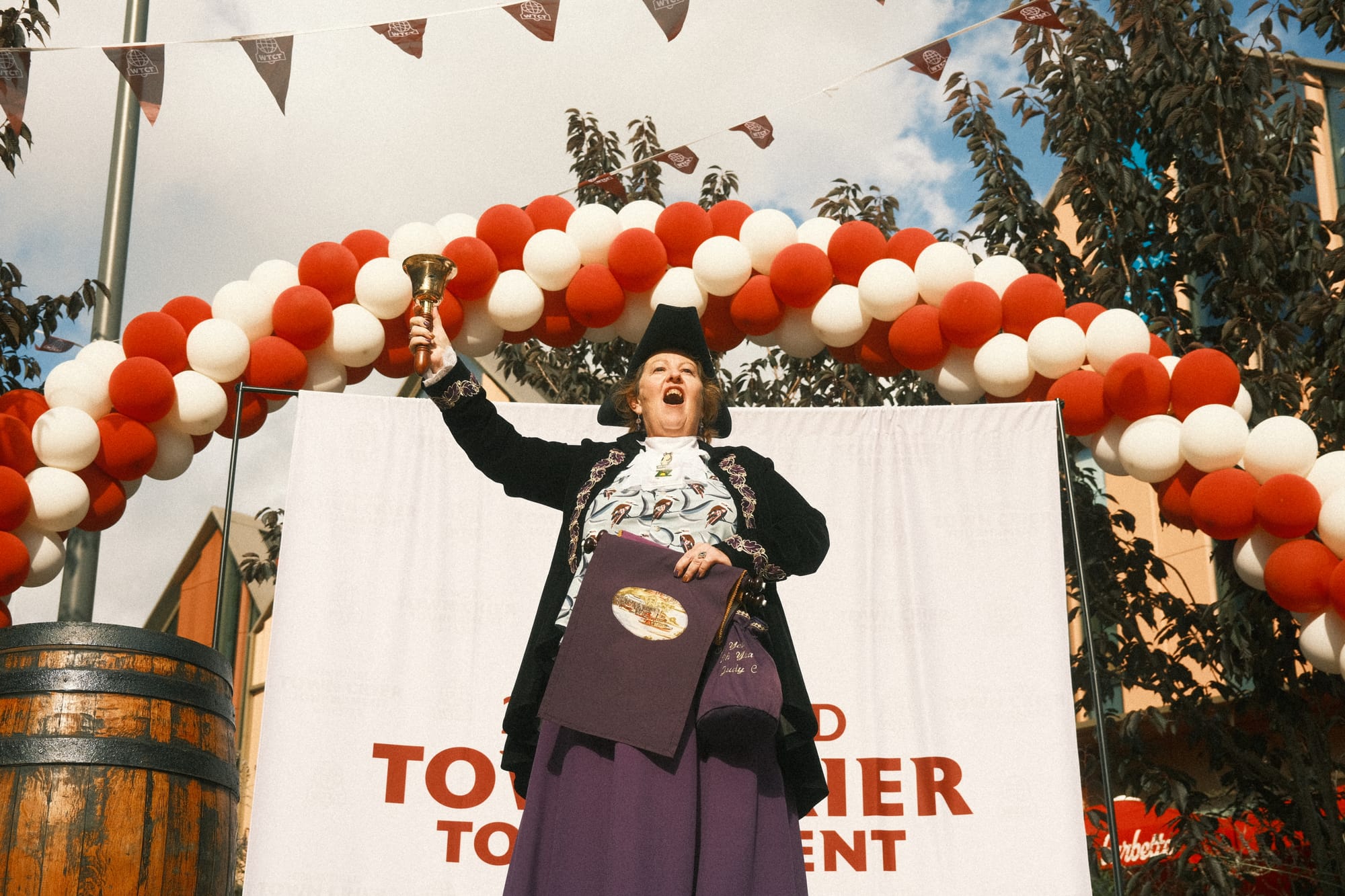
But the slackening of custom may not be the profession's most urgent threat. In Eastgate Square, each crier was tasked with composing a cry for a business within the shopping centre. Hearing their invitations to, say, “experience true luxury” or “visit Tribal Society's closest retail store” underscored the competition's reliance on corporate goodwill: the tournament was funded wholly through private firms such as Airbnb, which gave organisers £50,000.
On the world stage in Britain for the first time in 12 years, could town criers give a better account of themselves than being a series of resplendent pop-up ads?
Like most oral traditions, town crying has a patchy history. On a panel of the Bayeux Tapestry, two bellmen can be seen alongside the funeral procession of Edward the Confessor. This is the first known visual record of the profession — but, as Mitchell points out in For Crying Out Loud, his erudite account of the ancient office, the embroidered duo is often mistaken for evidence that town crying was a Norman invention introduced to Britain in 1066.
This is not a paywall!
To read this rest of this article, register for free.