
One Sunday afternoon in April, sitting in his family home in Nairobi, Adrian Waweru followed a routine familiar to thousands of ambitious young Kenyan writers: he went looking for a commission.
He didn't bother browsing traditional journalism job boards or leaning on a Rolodex of industry contacts. Instead, he opened TikTok.
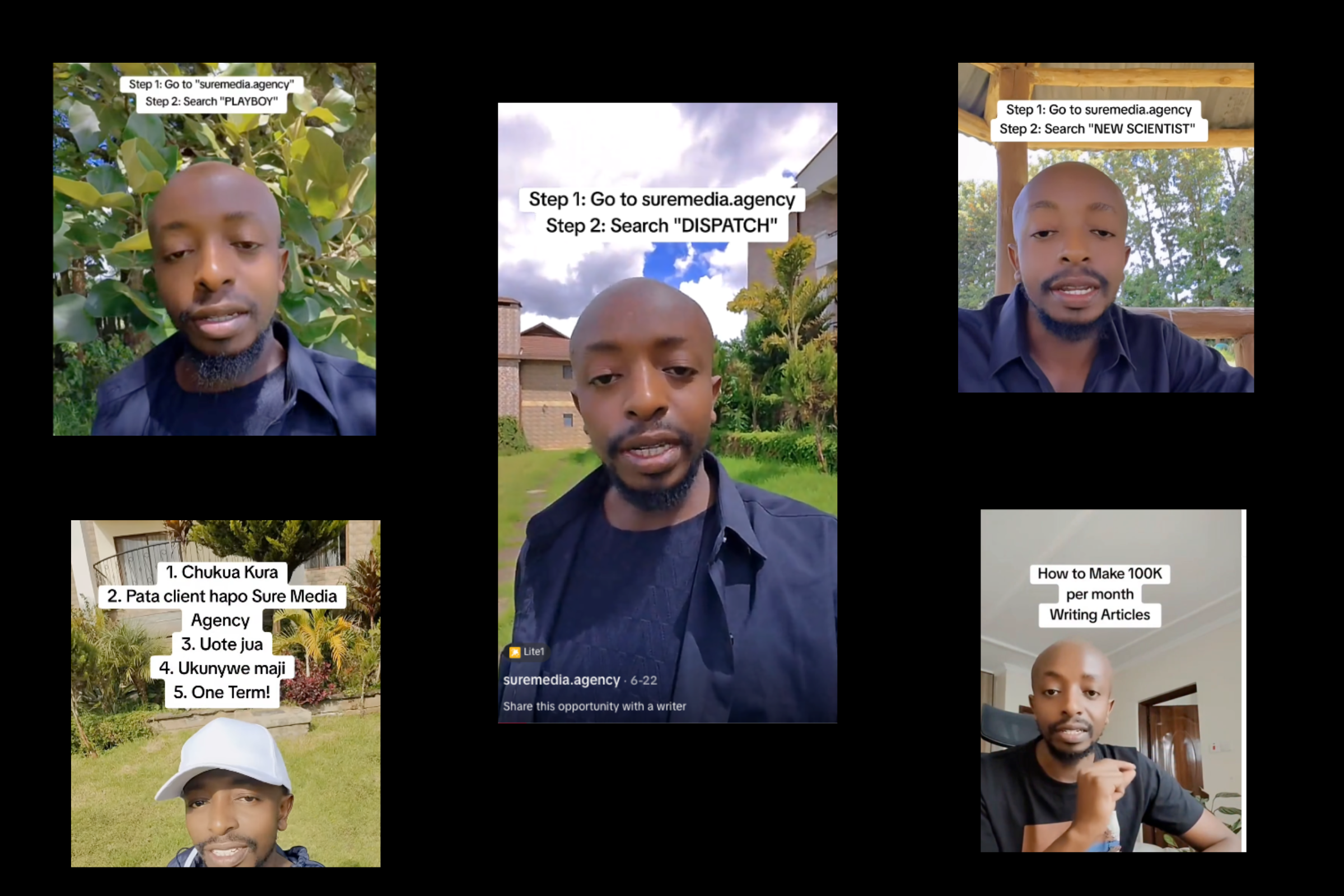
Earlier that week, while scrolling on his phone, he had come across a video from Sure Media Agency, a Kenyan platform that aggregates freelance opportunities from news organisations around the world and teaches its paid members how to use AI to secure a commission.
One listing caught his eye.
“Dispatch is actively commissioning freelance writers to pitch original feature stories,” the accompanying advert read. “If you're serious about landing high-paying freelance writing gigs and breaking into international magazines, this is a strategic byline to pursue.”
The advert went on to describe Dispatch as paying “around £400 per feature”, with reporting expenses covered. For the full details on how to pitch, readers were told to subscribe to Sure Media for 1,200 Kenyan shillings a month — about £6.90 or $10.
“I saw an avenue and just took it,” recalls Waweru, 25.
On paper, Waweru is among Kenya's fortunate young graduates. He works as an IT officer for the Ministry of Education, a secure public-sector role that many young Kenyans would envy. However, his ambitions stretch well beyond his day job. He recently started a personal blog and dreams of attracting an international audience.
A few days after reading the ad, Waweru’s pitch landed in Dispatch's inbox. It was titled: “Two Nairobis: A Story About One City That Has Never Fully Met Itself”.
“There is a neighbourhood in Nairobi,” it began, “where the restaurants have wine lists and the architecture would not look out of place in Amsterdam. Ten minutes away, on the other side of a road that functions as an invisible border, is a completely different city.”
He described growing up between those two worlds, “not comfortably, but constantly”. He added: “I live inside this story.”
The only problem: he didn't.
When Dispatch spoke to Waweru last month, he admitted that he had grown up in Nyeri, a town roughly 150 kilometres from Nairobi. The food vendor at the centre of the pitch came from a story a friend had told him. Much of the rest had been assembled from social media before being rewritten with Claude, Gemini and DeepSeek.
After being told that his pitch had been flagged by Dispatch's editors as AI-generated, he didn't argue. “It's very true,” he said. “If it felt so AI for them, yes, I understand, because I didn't have any other choice. I always integrate AI to write my stories. I want to align with what they want.”
His answer is revealing. For editors in Britain and America, generative AI has produced an unprecedented flood of polished but fabricated pitches. But in Kenya, it has achieved something else: it has provided an increasingly educated but underemployed generation with direct access to well-paying outlets in London and New York.
Much of that access runs through platforms like Sure Media.
Subscribers pay to receive curated opportunities, contact details for editors, access to writing workshops, and tips on how to use AI when brainstorming ideas or crafting a pitch. Sure Media’s founder Cyrus Wahome claims the platform has more than 13,500 subscribers, though it’s unclear how many pay. Also unverified are his claims that customers have placed articles in Forbes, Fortune, Wired, National Geographic, Vox, The Guardian, and BBC Travel.
This is not a paywall!
To read this rest of this article, register for free.